
Patellofemoral pain syndrome refers to pain that occurs on the front of the knee and is related to the knee cap (also known as the patella). The knee cap sits over the end of the thigh bone (femur) in a groove called the trochlea. It is inside the quadriceps tendon which connects the large quadriceps muscle on the front of the thigh to the shin bone (tibia).
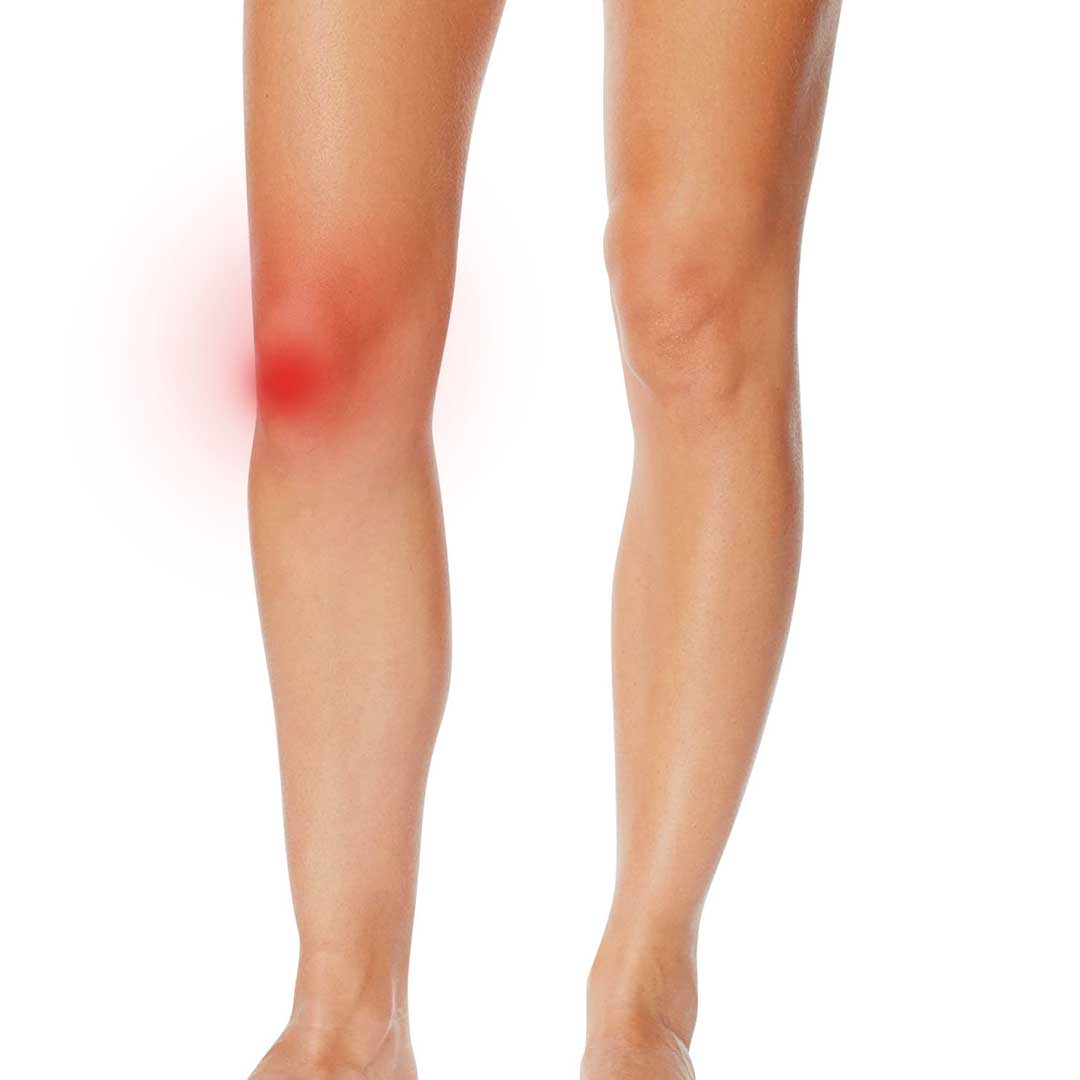
Symptoms of patellofemoral pain include:
- Pain on the front of the knee
- Pain can occur suddenly or over a more prolonged period of time
- Aggravated by squatting, stair climbing and/or prolonged sitting
It has been proposed that the causes of patellofemoral pain syndrome can be divided into four categories. A combination of causes is likely present and identifying the role they play and factors to manage them can be very important to successful treatment. These are:
- Overuse/overload – due to a period of substantially increased loading of the knee.
- Muscle performance deficits – due to weakness in hip and/or knee muscles. Some of this weakness may be present before the development of patellofemoral pain syndrome. However, some of this weakness may develop after the knee has become painful and limits recovery.
- Movement coordination deficits – due to poor knee stability during movement which causes the knee to drop to the inside (valgus).
- Mobility impairments – due to either hypermobility or hypomobility in the foot, ligaments that support the knee cap, the IT band and/or the muscles in the hip and knee.
Clinical practice guidelines recommend that exercise therapy is the primary treatment for patellofemoral pain syndrome. It has strong improvements in pain and function. Exercises should include hip strengthening (especially abduction, external rotation and extension), knee strengthening, knee control exercises and stretching. All of this is included in the Physio Fixes program.
Other interventions can include:
- Patellar taping techniques (such as the McConnell taping technique) for short-term symptom management. Clinically, if taping helps we find the use of a patellofemoral stabilizing brace can be useful.
- Insoles or orthotics may be beneficial if foot hypermobility is present and causes a flat foot which alters the biomechanics of the knee.
- Gait retraining during running encouraging a forefoot strike pattern, increasing cadence and correcting if the knee is dropping to the inside.
Follow the Physio Fixes program to learn more!
DISCLAIMER: This information is not intended as medical advice or a substitute for medical counseling. By choosing to follow the information that follows, you recognize that despite all precautions taken by Physio Fixes Inc. there is a potential risk of injury and you expressly acknowledge such risks and waive, relinquish, and release any claim that you may have against Physio Fixes Inc. You should always get evaluated for exercise by a physician or medical professionals, especially if symptoms occur from a trauma or are worsening. The user agrees by purchasing this program that Physio Fixes will not be held responsible in the event that an injury occurs.
References
Barton CJ, Lack S, Hemmings S, Tufail S, Morrissey D. The ‘Best Practice Guide to Conservative Management of Patellofemoral Pain’: incorporating level 1 evidence with expert clinical reasoning. Br J Sports Med. 2015 Jul;49(14):923-34. doi: 10.1136/bjsports-2014-093637. Epub 2015 Feb 25. PMID: 25716151.
Cara Elliott , Fraser Green , Karen Hang , Bronwen Jolliffe , McEvoy MP. Systematic Review of the Addition of Hip Strengthening Exercises for Adults with Patellofemoral Pain Syndrome. The Internet Journal of Allied Health Sciences and Practice. 2018 Jan 01;16(4), Article 10.
Clijsen R, Fuchs J, Taeymans J. Effectiveness of exercise therapy in treatment of patients with patellofemoral pain syndrome: systematic review and meta-analysis. Phys Ther. 2014 Dec;94(12):1697-708. doi: 10.2522/ptj.20130310. Epub 2014 Jul 31. Erratum in: Phys Ther. 2015 Jun;95(6):944. PMID: 25082920.
Collins NJ, Barton CJ, van Middelkoop M, Callaghan MJ, Rathleff MS, Vicenzino BT, Davis IS, Powers CM, Macri EM, Hart HF, de Oliveira Silva D, Crossley KM. 2018 Consensus statement on exercise therapy and physical interventions (orthoses, taping and manual therapy) to treat patellofemoral pain: recommendations from the 5th International Patellofemoral Pain Research Retreat, Gold Coast, Australia, 2017. Br J Sports Med. 2018 Sep;52(18):1170-1178. doi: 10.1136/bjsports-2018-099397. Epub 2018 Jun 20. PMID: 29925502.
Crossley K, Bennell K, Green S, McConnell J. A systematic review of physical interventions for patellofemoral pain syndrome. Clin J Sport Med. 2001 Apr;11(2):103-10. doi: 10.1097/00042752-200104000-00007. PMID: 11403109.
Kooiker L, Van De Port IG, Weir A, Moen MH. Effects of physical therapist-guided quadriceps-strengthening exercises for the treatment of patellofemoral pain syndrome: a systematic review. J Orthop Sports Phys Ther. 2014 Jun;44(6):391-402, B1. doi: 10.2519/jospt.2014.4127. Epub 2014 Apr 25. PMID: 24766358.
Lack S, Barton C, Sohan O, Crossley K, Morrissey D. Proximal muscle rehabilitation is effective for patellofemoral pain: a systematic review with meta-analysis. Br J Sports Med. 2015 Nov;49(21):1365-76. doi: 10.1136/bjsports-2015-094723. Epub 2015 Jul 14. PMID: 26175019.
Saltychev M, Dutton RA, Laimi K, Beaupré GS, Virolainen P, Fredericson M. Effectiveness of conservative treatment for patellofemoral pain syndrome: A systematic review and meta-analysis. J Rehabil Med. 2018 May 8;50(5):393-401. doi: 10.2340/16501977-2295. PMID: 29392329.
Wallis JA, Roddy L, Bottrell J, Parslow S, Taylor NF. A Systematic Review of Clinical Practice Guidelines for Physical Therapist Management of Patellofemoral Pain. Phys Ther. 2021 Mar 3;101(3):pzab021. doi: 10.1093/ptj/pzab021. PMID: 33533400.
Wilk KE, Davies GJ, Mangine RE, Malone TR. Patellofemoral disorders: a classification system and clinical guidelines for nonoperative rehabilitation. J Orthop Sports Phys Ther. 1998 Nov;28(5):307-22. doi: 10.2519/jospt.1998.28.5.307. PMID: 9809279.
Willy RW, Hoglund LT, Barton CJ, Bolgla LA, Scalzitti DA, Logerstedt DS, Lynch AD, Snyder-Mackler L, McDonough CM. Patellofemoral Pain. J Orthop Sports Phys Ther. 2019 Sep;49(9):CPG1-CPG95. doi: 10.2519/jospt.2019.0302. PMID: 31475628.
