
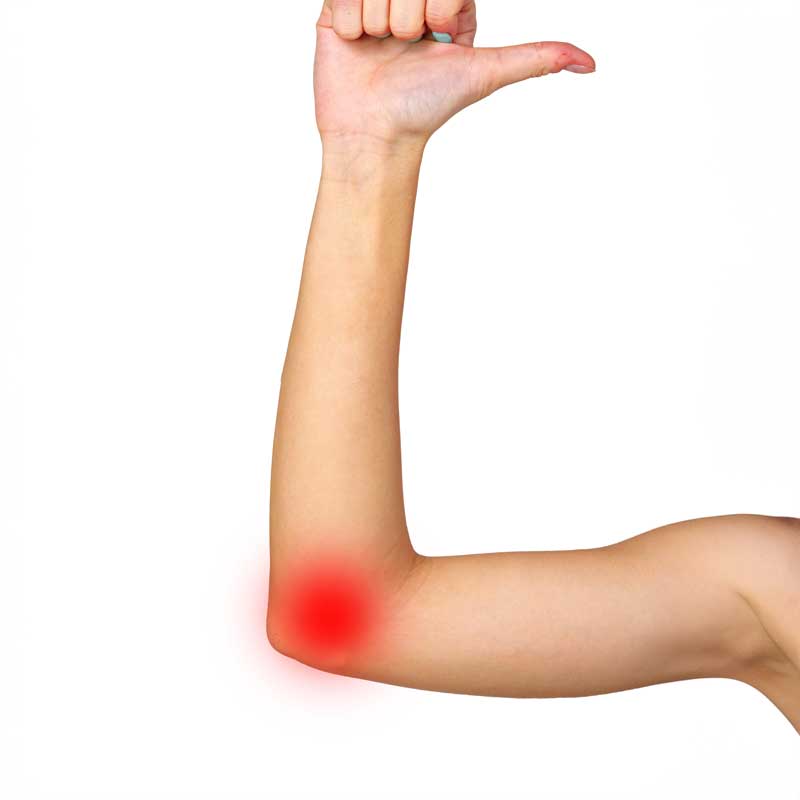
Medial epicondylalgia is commonly referred to as golfers elbow and is an overuse injury of the flexor muscles of the wrist and fingers which insert on the inside of the elbow. It is similar to lateral epicondylalgia/tennis elbow, it just happens on the opposite side of the elbow. This overload is often caused by repetitive gripping, twisting, wrist flexion and throwing motions. These motions can occur in golf, but they can also occur in racquet or throwing sports, weight training, occupations forceful repeated movements (ie. twisting wrench) or occupations with a high volume of lower force repetitive movements (ie. typing).
Signs of medial epicondylalgia/golfers elbow include:
- Pain on the inside of your elbow and forearm,
- Pain is made worse by use and better with rest.
- It does not cause any sensory changes such as tingling or numbness in your forearm or hand.
Conservative management of medial epicondylalgia starts with a brief period of decreased loading to reduce symptom severity. A brace can be useful to help control the amount of loading to the tendon.. Other factors to consider are:
- Making sure you are using proper lifting techniques
- Make sure you are using the right equipment
- Taking breaks as needed (this will vary person to person)
This is followed by progressive strengthening in the arm to build the capacity of the tissues and stimulate healing. Strengthening of the tissues is by far the most important part as it will prevent a reoccurrence of your injury and stimulate the tissues to heal.
Please see below for a step-by-step guide on medial epicondylalgia rehabilitation exercises.
DISCLAIMER: This information is not intended as medical advice or a substitute for medical counseling. By choosing to follow the information that follows, you recognize that despite all precautions taken by Physio Fixes Inc. there is a potential risk of injury and you expressly acknowledge such risks and waive, relinquish, and release any claim that you may have against Physio Fixes Inc. You should always get evaluated for exercise by a physician or medical professionals, especially if symptoms occur from a trauma or are worsening. The user agrees by purchasing this program that Physio Fixes will not be held responsible in the event that an injury occurs.
References
Amin NH, Kumar NS, Schickendantz MS. Medial epicondylitis: evaluation and management. JAAOS-Journal of the American Academy of Orthopaedic Surgeons. 2015 Jun 1;23(6):348-55.
Markschickendantz M. 28 Medial: Flexor-Pronator Tendon Injury. Shoulder and Elbow Injuries in Athletes: Prevention, Treatment and Return to Sport. 2017 Oct 17:461.
Hoogvliet P, Randsdorp MS, Dingemanse R, Koes BW, Huisstede BM. Does effectiveness of exercise therapy and mobilisation techniques offer guidance for the treatment of lateral and medial epicondylitis? A systematic review. Br J Sports Med. 2013 Nov 1;47(17):1112-9.
Michael C. Ciccotti , MA, RA, Michael A. Schwartz, MD, Michael G. Ciccotti, MD. Diagnosis and treatment of medial epicondylitis of the elbow. Clin Sports Med 23 (2004) 693-705
Ciccotti MC. Diagnosis and treatment of medial epicondylitis of the elbow. Clin Sports Med. 2004.
Todd S. Ellenbecker RNPR. Current Concepts in Examination and Treatment of Elbow Tendon Injury. Sports Health; 5(2): 186–194. 2013 March.
